Don't Automate a Broken Process
AI agents are the trend of the year, and most of the pitches you're hearing skip the part where automation amplifies whatever it's pointed at. If the process underneath is broken, you don't get cleanup. You get faster mess.
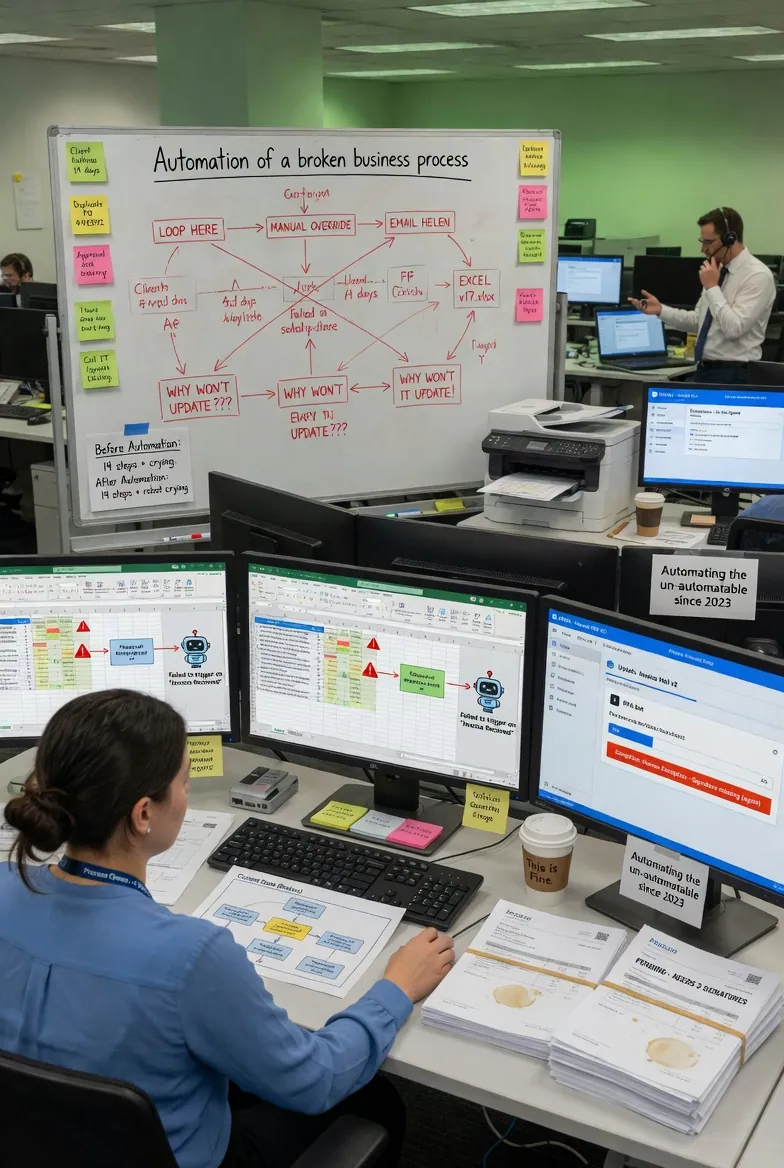
Here's a story I've heard a few versions of in the last few months.
A small business owner gets sold on an AI agent that's going to handle her lead follow-up. The setup goes well. Within a week the agent is sending replies to new inquiries inside of two or three minutes, which is faster than she's ever managed it herself. The dashboard shows green. Replies sent. Conversations started. By every visible metric, the thing is working.
About three weeks in, she starts noticing things. A referral she'd met for coffee got a generic cold-style pitch that landed weirdly. A lead who'd already booked got two follow-up messages asking if she wanted to book. A regular customer who'd asked a simple question about hours got something that read like a sales script.
She turns the agent off and goes back to handling it herself on Sunday nights. Slower, but at least she knew which conversations she was actually in.
AI is still a multiplier
I've written before about AI being a multiplier on whatever's already in the chair. That was in the context of hiring developers, but the same idea applies to your business, not just to the people writing code.
Right now is the loudest year I can remember for selling automation. About 82% of small business employers say they've invested in AI tools, and a lot of that investment is going into agents that promise to handle whole workflows: lead follow-up, scheduling, intake, light support. Some of those products are good. None of them fix what they're pointed at. They speed it up.
That's the trade nobody quite warns you about in the demo. The demo shows the polished version of a process. Your actual process is messier than that, and the agent is going to run on the actual process.
What "broken" looks like at small-business scale
When I say "broken process," I don't mean anything dramatic. I mean the normal stuff that builds up in any business that's been operating for more than a year or two.
It's the lead follow-up that nobody really owns. Some weeks the receptionist gets to it on Wednesday afternoon. Other weeks you handle it yourself on Sunday night. Sometimes a week goes by before anybody notices the inbox at all.
It's the intake form that lands in three different inboxes depending on which page on the site the customer filled it out from, and only one of those inboxes is checked daily. It's the standing knowledge that the back-office spreadsheet needs to be updated on Tuesdays, which lives in exactly one person's head and has never been written down anywhere.
It's the pricing exception you cut for one good customer because of a conversation in 2023, sitting unwritten between you and that customer and nobody else. It's the customer status that's a phone call to one person, an email to another, and a CRM note for a third, where the three sources don't agree.
These aren't problems exactly. They're seams. The business runs on top of them because there's a person in the middle who knows which of the three sources to trust on a given Tuesday. Slow, but coherent.
What happens when you automate around them
When you put automation on top of all that, the seams stop being soft.
The agent doesn't know that the lead who came in through the contact page is the same lead who already replied through the booking widget. So it sends a follow-up. The system doesn't know which of the three inboxes is authoritative, so it picks one and acts on what it finds there. The pricing exception isn't in the rules the agent was given, so the agent quotes the regular price and the customer notices.
None of that is the agent's fault. It's doing the job. The job just happened to include a lot of judgment calls that used to live in someone's head, and now they don't.
What makes this different from a slow process going wrong is the speed and the confidence. A human handling lead follow-up on Sunday night might make a mistake, but they'd usually catch it the next morning. An agent makes the same mistake at four in the afternoon, sends a polished message, marks the task complete in the dashboard, and moves on. By the time you find out, it's already happened thirty times.
The thing that was keeping the old process honest was often the bottleneck itself. The person in the middle was slow, but they were a soft check. Strip them out without replacing what they were doing, and you get more output, more confident output, and more wrong output, in roughly equal amounts.
What actually pays off
The work that pays off, in my experience, is almost always the work that happens before the automation.
It looks unglamorous. Sit down with the owner. Walk through what actually happens when a lead comes in, from the first touch to the booked appointment. Find the places where there are three inboxes, or one undocumented exception, or one piece of tribal knowledge that's keeping the whole thing standing. Decide which of those need to be cleaned up, which need to be written down, and which actually need a tool.
What usually comes out the other side is smaller than the original pitch suggested. Sometimes there's no agent at all, just a tightened-up form, a single inbox, and a one-page document that finally writes down the rules. Sometimes there's a small piece of custom automation that handles the specific cleaned-up workflow, and it's a smaller, narrower piece of work than what was originally on the table. Most of the custom software solutions I build for Omaha businesses start out exactly that way.
I'm not anti-automation. I lean on it heavily in my own work. The point isn't that the tools are bad. It's that the tools amplify, and amplification only works in your favor if the thing underneath is something you'd want amplified.
If you're reading this
If you're a few months into an automation that isn't paying off, or you're about to sign for an AI agent and you're not sure whether your process is in shape for it yet, that's a conversation I'd rather have early than late.
— Nathan